In our press portal you can find current press releases, pictures, videos, information about fairs and events as well as studies and other publications.
Continental is a leading tire manufacturer and industry specialist that develops and produces sustainable, safe and convenient solutions for automotive manufacturers as well as industrial and end customers worldwide.
Download To create a varied website, content can be displayed in different ways. For this purpose, there are special modules whose appearance is optimized for their function. Content Blocks...
Elements Elements are the basic building blocks of a website. They are based on the design foundation and are usually used in modules. Elements can be grouped into segments. Elements and segments cannot...
Icons & Symbols Universal icons and symbols are the visual expression of usability and utility. When designed to be intuitive, icons and symbols make a website much easier to use. While each icon should be...
Typography Continental Stage Sans Continental Stag Sans is the corporate typeface. It conveys the strength, competence and modernity of the brand and at the same time draws attention to headlines without...
Teaser Teasers are used to guide the user through the website. Related content can be presented and enables the user to browse the site. It is a great possibility to present and highlight content. Category...
Colors The consistent use of color strengthens our brand and builds trust and recognition. For the design of complex information architectures, a more sophisticated color palette is essential....
Stages Stages are used at the top of a website and inform the user about the topic of the page. Each page has exactly one stage. Category Overview Content Blocks Icons/20x20/Arrow right Go to Page
...
Latest developments in tire technologies, scientific advances in measurement methods and their impact on Continental’s sustainability agenda are the focus of the three-day technical conference
5 Document(s)
Picture
Mobilitätsstudie 2015 (RGB)
Mobilitätsstudie 2015 (RGB)
July 23, 2018 Vernunft oder Emotion?
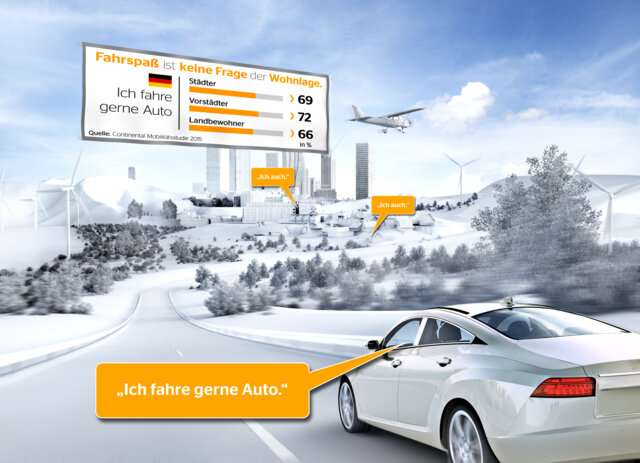
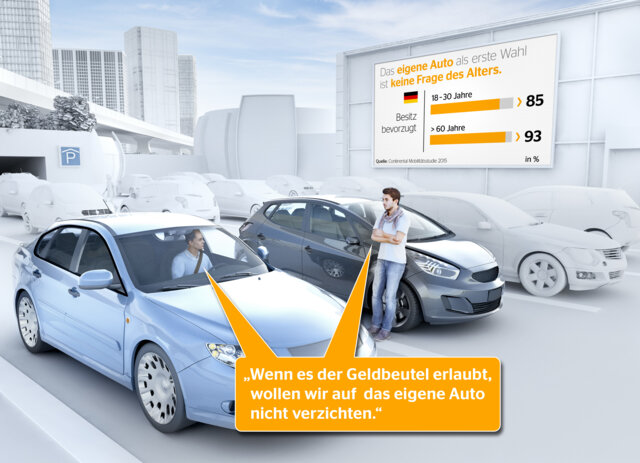
Welche Bedeutung hat Autofahren weltweit? Wird individuelle Mobilität zukünftig mehr von rationalen als von emotionalen Beweggründen geleitet? Wollen junge Menschen Autos überhaupt noch besitzen? Wie steht es um die Akzeptanz neuer Technologien wie Elektromobilität, Digitalisierung und automatisiertes Fahren? Dies sind zentrale Fragestellungen der Continental Mobilitätsstudie 2015.
Im Auftrag des internationalen Automobilzulieferers Continental wurden in der zweiten Jahreshälfte 2014 von infas in Deutschland 1.800 und in den USA 2.300 (Nicht-)Autofahrer (repräsentativ) sowie jeweils 400 Fahrzeughalter (qualitativ) in Deutschland, den USA, Frankreich, Japan und China befragt. Interviews mit Experten aus der Automobilindustrie und Forschung ergänzen die Studienergebnisse um die fachliche Betrachtungsweise.
This picture/video may be used by journalists and media representatives when reporting about Continental, provided the source is cited.
When using this material, please specify the following source: "Photo: Continental AG" or "Video: Continental AG".
If you would like to use our pictures or videos in another context, such as for advertising brochures, websites or other commercial purposes, please contact us prior to doing so.
Vernunft oder Emotion?
Welche Bedeutung hat Autofahren weltweit? Wird individuelle Mobilität zukünftig mehr von rationalen als von emotionalen Beweggründen geleitet? Wollen junge Menschen Autos überhaupt noch besitzen? Wie steht es um die Akzeptanz neuer Technologien wie Elektromobilität, Digitalisierung und automatisiertes Fahren? Dies sind zentrale Fragestellungen der Continental Mobilitätsstudie 2015.
Im Auftrag des internationalen Automobilzulieferers Continental wurden in der zweiten Jahreshälfte 2014 von infas in Deutschland 1.800 und in den USA 2.300 (Nicht-)Autofahrer (repräsentativ) sowie jeweils 400 Fahrzeughalter (qualitativ) in Deutschland, den USA, Frankreich, Japan und China befragt. Interviews mit Experten aus der Automobilindustrie und Forschung ergänzen die Studienergebnisse um die fachliche Betrachtungsweise.
July 24, 2018 Vernunft oder Emotion?
Welche Bedeutung hat Autofahren weltweit? Wird individuelle Mobilität zukünftig mehr von rationalen als von emotionalen Beweggründen geleitet? Wollen junge Menschen Autos überhaupt noch besitzen? Wie steht es um die Akzeptanz neuer Technologien wie Elektromobilität, Digitalisierung und automatisiertes Fahren? Dies sind zentrale Fragestellungen der Continental Mobilitätsstudie 2015.
Im Auftrag des internationalen Automobilzulieferers Continental wurden in der zweiten Jahreshälfte 2014 von infas in Deutschland 1.800 und in den USA 2.300 (Nicht-)Autofahrer (repräsentativ) sowie jeweils 400 Fahrzeughalter (qualitativ) in Deutschland, den USA, Frankreich, Japan und China befragt. Interviews mit Experten aus der Automobilindustrie und Forschung ergänzen die Studienergebnisse um die fachliche Betrachtungsweise.
This picture/video may be used by journalists and media representatives when reporting about Continental, provided the source is cited.
When using this material, please specify the following source: "Photo: Continental AG" or "Video: Continental AG".
If you would like to use our pictures or videos in another context, such as for advertising brochures, websites or other commercial purposes, please contact us prior to doing so.
Vernunft oder Emotion?
Welche Bedeutung hat Autofahren weltweit? Wird individuelle Mobilität zukünftig mehr von rationalen als von emotionalen Beweggründen geleitet? Wollen junge Menschen Autos überhaupt noch besitzen? Wie steht es um die Akzeptanz neuer Technologien wie Elektromobilität, Digitalisierung und automatisiertes Fahren? Dies sind zentrale Fragestellungen der Continental Mobilitätsstudie 2015.
Im Auftrag des internationalen Automobilzulieferers Continental wurden in der zweiten Jahreshälfte 2014 von infas in Deutschland 1.800 und in den USA 2.300 (Nicht-)Autofahrer (repräsentativ) sowie jeweils 400 Fahrzeughalter (qualitativ) in Deutschland, den USA, Frankreich, Japan und China befragt. Interviews mit Experten aus der Automobilindustrie und Forschung ergänzen die Studienergebnisse um die fachliche Betrachtungsweise.