Continental Equips Six Tour de France Teams with Road Bike Tires
- Over a quarter of the peloton will ride on tires made in Korbach, Germany
- More than 1,000 road bike tires from Continental will be used at this year’s Tour de France
- The same pro-level tires are available to recreational riders
- Hannah Ferle, Continental product expert for bicycle tires: “The trust placed in us by the six teams is both an honor and an incentive. The Tour is decided by the smallest details: on every stage, in every kind of weather and on every surface”
- Pelayo Sánchez, a rider on the Movistar team: “To focus on our legs, we need to be able to rely on tires that deliver top performance at all times”

Hanover, Germany, June 23, 2026. Continental has supplied road bike tires to six teams competing in this year’s Tour de France. From July 4 to 26, over a quarter of the peloton will ride on tires made at Continental’s Korbach plant in Hesse, Germany. More than 1,000 road bike tires will be used over the course of the three-week event, with every tire produced and tested in Korbach. Teams riding on Continental tires at the 113th Tour de France include Groupama-FDJ United, UAE Team Emirates – XRG, Movistar Team, Bahrain-Victorious, Decathlon CMA CGM and Uno-X Mobility. The race spans 21 stages and 3,333 kilometers, starting in Barcelona, Spain, and finishing on the Champs-Élysées in Paris, France.
“The trust placed in us by the six teams is both an honor and an incentive. The Tour is decided by the smallest details: on every stage, in every kind of weather and on every surface. That is why we put so much time and effort into developing our tires in close collaboration with the professional racing teams. And ultimately, recreational riders benefit as well,” said Hannah Ferle, Continental product expert for bicycle tires.
Four tires for different stage demands

The teams can choose from four different Continental tires to meet the demands of each stage. The main tire is the Grand Prix 5000 S TR, which weighs between 250 and around 365 grams, depending on the size. This tire offers the optimal balance of rolling resistance, puncture protection and weight, making it suitable for a wide range of stages. For example, it features an integrated puncture-protection layer to help guard against punctures while riding.
In variable weather conditions, teams use the all-season Grand Prix 5000 AS TR, which provides enhanced grip, especially on wet asphalt.

The Grand Prix 5000 TT TR is the lightweight tire in the road bike range and is used primarily for time trials thanks to its low weight and rolling resistance. For windy stages, teams turn to the Aero 111 tire, whose aerodynamically optimized tread pattern on the front wheel helps guide airflow and reduces turbulence. All four models are tubeless-ready, which means they can be set up to run without an inner tube. In a tubeless setup, sealant added to the tire automatically seals small punctures while riding.
Since the first Tour de France in 1903, average speeds have risen from around 25 to over 40 kilometers per hour, even as the stages have become more challenging.“Sometimes a race is decided by a fraction of a second. To focus on our legs, we need to be able to rely on tires that deliver top performance at all times,” said Pelayo Sánchez, a rider on the Movistar team.
Pro-level technology for recreational riders
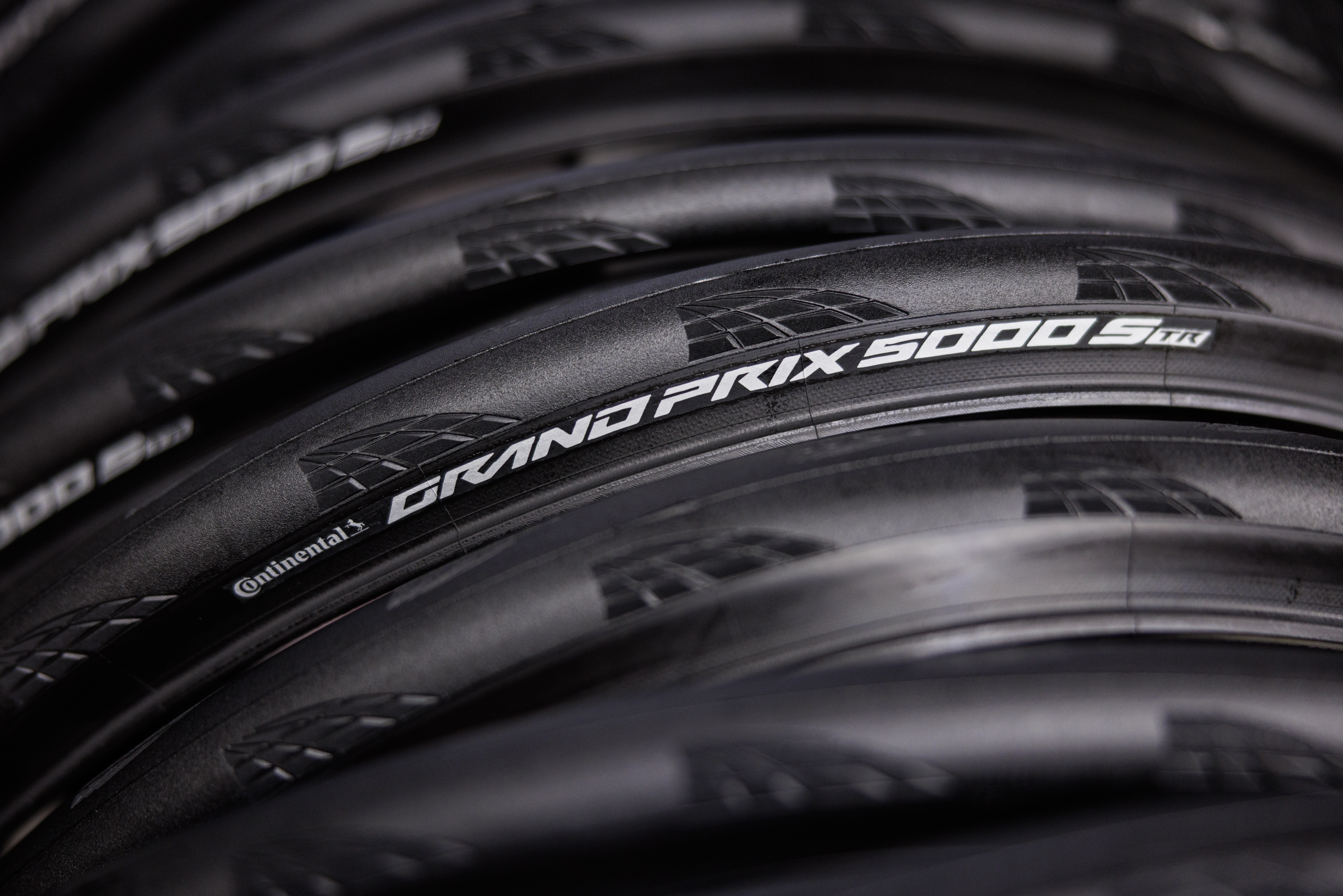
The tires used in the Tour are commercially available. That means recreational riders can buy the same tires used by the professionals. They feature the rubber compound developed in Korbach, an integrated puncture-protection layer and the tubeless-ready design. Experience gained in racing helps shape the ongoing development of these tires.
The Tour as a source of development data
Continental develops its road bike tires using data from the lab and insights from racing. In the lab, test rigs measure rolling resistance, grip and durability. The tires rotate on a steel drum while sensors measure forces and temperatures. The results can be reproduced and help guide decisions on materials. In racing, professional riders provide additional information about grip, handling and puncture resistance under varying asphalt conditions, in heat, in rain and through high-speed corners. “Professional cycling exposes us to conditions that we cannot replicate in the lab. These experiences flow directly into development – for use in racing and for everyday use on the road,” said Hannah Ferle.
A road bike tire must meet several requirements at the same time that are often at odds with one another. Low weight, high grip, low rolling resistance and advanced puncture protection are all essential. However, lower rolling resistance usually reduces grip, while greater puncture protection adds weight. Continental balances these competing properties through the composition of the rubber compound and the tire’s construction. The arrangement of reinforcing layers beneath the tread determines stability and puncture protection. The composition of polymers and fillers determines how the tire behaves in hot, wet and cold conditions.
Continental also equips support vehicles and motorbikes
Continental’s presence at the 2026 Tour de France extends beyond the racing bikes. More than 70 support vehicles and around 30 motorbikes will run on Continental tires from the first stage to the last. These include the EcoContact 6, PremiumContact 7 and UltraContact NXT. Continental is also an official main partner of the Tour de France and will present the stage winners with their trophies on the podium.